Nano Banana 2.1 Price: $0.0336 an Image, Half of Nano Banana 2, but Edits Still Drift
RenderHour · October 27, 2026 · 9 min read
In short
- Nano Banana 2.1, released by Google on October 6, 2026, costs $0.0336 for a 1K image on the Gemini API, half of Nano Banana 2’s $0.067. It runs on Gemini 3.6 Flash.
- Its edits still drift: in the Edit Drift test, 40 edits in a row on one photo, it kept untouched areas at 54.9 out of 100, against 56.0 for Nano Banana 2 and 96.8 for FLUX 3.
- On RenderHour it costs 3 credits a 1K image, about half of Nano Banana 2’s 5.75, and it is one of the models the free plan covers.

Google cut the price of its fast image model in half, but not its habit of repainting what you did not ask it to touch. Nano Banana 2.1 makes a 1K image for $0.0336 on the Gemini API against $0.067 for Nano Banana 2, and Google’s own tests rate it above both Nano Banana 2 and Nano Banana Pro. In an independent test of 40 edits in a row, though, it changed the untouched parts of the photo slightly more than Nano Banana 2 did. You can try Nano Banana 2.1 on RenderHour for 3 credits an image.
What is Nano Banana 2.1?
Nano Banana 2.1 is Google’s image generation and editing model, an update to Nano Banana 2 (Gemini 3.1 Flash Image) built on Gemini 3.6 Flash. Google published its model card on October 6, 2026. It is in the Gemini app, Google AI Studio, the Gemini API, Search AI Mode, Google Ads, Flow and Stitch.
- Better pictures, by Google’s own votes: 1,050 Elo for overall preference with thinking on, against 990 for Nano Banana 2 and 935 for Nano Banana Pro.
- Characters and products hold better: multi-character consistency rose from 978 to 1,106, product consistency from 955 to 1,024.
- Panoramas fixed: fal notes that Google fixed the tiling artifacts that wide formats showed at 2K and 4K.
- Gone: the 512-pixel size that Nano Banana 2 offered.
- Still weak, per the model card: small text, telling left from right, and keeping characters consistent every time.
| Test | Nano Banana 2.1 (thinking) | Nano Banana 2 | Nano Banana Pro |
|---|---|---|---|
| Overall preference | 1,050 | 990 | 935 |
| General editing | 1,026 | 938 | 939 |
| Multi-character consistency | 1,106 | 978 | 1,011 |
| Product consistency | 1,024 | 955 | 965 |
| Multi-reference editing | 1,066 | 988 | 989 |
| Infographic factuality (score) | 0.521 | 0.179 | 0.265 |
Source: Google DeepMind, Nano Banana 2.1 model card, October 6, 2026. These are Google’s own tests.
How much does Nano Banana 2.1 cost?
- Nano Banana 2.1$0.0336
- Nano Banana 2$0.067
- Nano Banana Pro$0.134
Source: Gemini API pricing, read October 27, 2026.
| Nano Banana 2.1 | Nano Banana 2 | Nano Banana Pro | |
|---|---|---|---|
| 1K image | $0.0336 | $0.067 | $0.134 |
| 2K image | $0.0504 | $0.101 | $0.134 |
| 4K image | $0.113 | $0.151 | $0.24 |
| 1K image, batch | $0.0168 | $0.034 | $0.067 |
| Image output, per 1M tokens | $30 | $60 | $120 |
| Input, per 1M tokens | $1.50 | $0.50 | $2.00 |
| Thinking, per 1M tokens | $7.50 | $3.00 | $12.00 |
Source: Google, Gemini API pricing, standard paid tier.
Read the last two rows before you celebrate. The output image is half price, but input costs 3 times as much as on Nano Banana 2 and thinking 2.5 times as much. A plain prompt gets cheaper; an edit that sends several large reference photos and thinks hard saves less, and could cost more.
On RenderHour there are no tokens to count: Nano Banana 2.1 is 3 credits at 1K, 4.25 at 2K and 9.5 at 4K, against 5.75 for Nano Banana 2 at 1K. On Plus billed yearly, about 3.9 cents a credit, a 1K image comes to about 12 cents by our arithmetic.
- Nano Banana 2.13
- FLUX 3 Image3.5
- Grok Imagine 2.04.25
- Seedream 5.0 Pro4.75
- Nano Banana 25.75
- Nano Banana Pro10.75
- GPT Image 216.5
Source: RenderHour price list, October 27, 2026.
Do Nano Banana 2.1 edits drift?
Yes, a little more than before. Edit Drift, a benchmark published on GitHub by MightyKing in October 2026, gives each model the same photo and the same 40 edits in a row, each made on the previous result. It then measures how much the parts of the photo that no edit touched have changed. The score is 100 minus the average change on a 0 to 255 pixel scale, so 100 means nothing moved.
- Ideogram 4.5 (mask)99.0
- FLUX 3 (box)96.8
- GPT Image 2.5 (mask)73.4
- Seedream 5 Pro67.1
- GPT Image 2 (mask)61.2
- Grok Imagine 2.058.5
- Nano Banana 256.0
- Nano Banana 2.154.9
- Nano Banana 2.1 (one chat)48.5
- Seedream 4.531.9
Source: Edit Drift by MightyKing, October 2026. Models without a mark got a plain instruction.
The top of the board is not a fair fight, and the author says so. FLUX 3 was given a box around the area to change, and Ideogram and GPT Image a mask; the Gemini API used here has no such field, so Nano Banana was told the object in the prompt. It is also one run on one photo, and the score measures what stayed the same, not how good the edits look. Still, two findings stand: Nano Banana 2.1 drifts slightly more than Nano Banana 2, and it drifts more again (48.5) when all 40 edits run in one conversation instead of one call each.
Our test: 3 edits, 12 credits
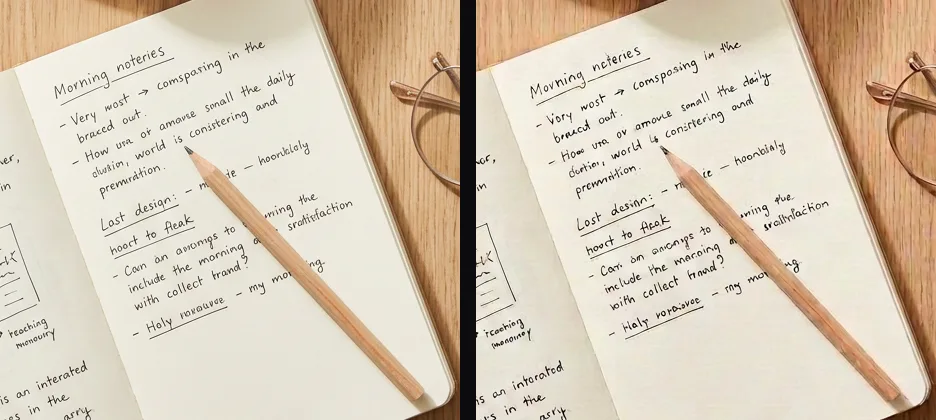
We ran a short version on RenderHour on October 27, 2026: one flat lay, then 3 edits, each on the last result, each ending with “Keep everything else in the photo exactly the same.” No edit mentions the notebook.



Every edit did what it asked, cleanly: the muffin sits on the same plate, the cup turns black with its latte art intact, the tulips take the eucalyptus’s place. Then we measured the notebook and pencil, the bottom-left area of the frame (60% of its width, 54% of its height), pixel by pixel against the first image.
- After edit 13.11
- After edit 25.10
- After edit 36.97
Source: RenderHour test on Nano Banana 2.1, 1K, October 27, 2026; one run.
Each edit moved the notebook by about 3 points, and the changes added up rather than cancelling out. You cannot see it at a glance, but you can read it: the model redrew the handwriting every time. “compsparing” became “composing” and “design” became “desinn”. The words were made-up scribbles to begin with, which fits the model card’s note on small text.
Nano Banana 2.1 in 6 numbers
- $0.0336: a 1K image on the Gemini API, half of Nano Banana 2’s $0.067.
- $0.0168: the same image in batch mode, the lowest price Google lists for a Nano Banana.
- 3 times: how much more input tokens cost than on Nano Banana 2 ($1.50 against $0.50 per million).
- +128 Elo: multi-character consistency over Nano Banana 2 in Google’s tests, the biggest gain on the card.
- 1.1 points: how much lower it scores than Nano Banana 2 on Edit Drift (54.9 against 56.0).
- 3 images: what RenderHour’s 10 free starter credits buy at 1K, no card needed.
What Nano Banana 2.1 means if you make content for social and ads
- Use it for volume. At half the price, it is the model for carousels, thumbnails and the dozens of variants an ad test needs.
- Edit from the original, not the last edit. Drift adds up, so when a picture needs 5 changes, put them in one prompt, or start each edit from the clean first image.
- Check small text and product labels after every edit. Our notebook was rewritten without being asked. For packaging, keep the real product photo as a reference.
- Pick FLUX 3 when the rest of the frame must not move. It scored 96.8 on Edit Drift with a box. On RenderHour, FLUX 3 Image edits from a prompt and reference images, without a box for now.
- Need the best detail? Compare first. Nano Banana 2.1 vs Nano Banana Pro sets the two side by side; Pro costs 10.75 credits an image here.
Thousands of images a year, from one subscription
Plus billed yearly is $564 for 1,200 credits a month, about 3.9 cents a credit: up to 400 Nano Banana 2.1 images a month at 1K, or any mix with Kling, Seedance, Veo and FLUX. Yearly billing costs less than paying month by month.
See yearly plansQuestions
- How much does Nano Banana 2.1 cost?
- On the Gemini API, $0.0336 for a 1K image, $0.0504 at 2K and $0.113 at 4K, half of Nano Banana 2 at 1K and 2K. Input and thinking tokens cost more than before. On RenderHour it is 3 credits at 1K, 4.25 at 2K and 9.5 at 4K.
- Can I use Nano Banana 2.1 for free?
- Yes, on RenderHour (renderhour.com): every new account gets 10 credits with no card, and Nano Banana 2.1 is one of the free-plan models, so that is 3 images at 1K. Google also offers it in the Gemini app.
- Is Nano Banana 2.1 better than Nano Banana 2?
- In Google’s tests, yes: 1,050 against 990 Elo for overall preference, and big gains in character and product consistency. It costs half as much per output image. On the independent Edit Drift test it kept untouched areas slightly worse, 54.9 against 56.0.
- When was Nano Banana 2.1 released?
- Google published the Nano Banana 2.1 model card on October 6, 2026. The model is based on Gemini 3.6 Flash and replaces Nano Banana 2 (Gemini 3.1 Flash Image).
- What is Edit Drift?
- A benchmark by MightyKing, published on GitHub in October 2026. Each image model makes the same 40 edits in a row on one photo, and the score shows how much the untouched areas changed: 100 means not at all. Ideogram 4.5 scored 99.0, FLUX 3 96.8 and Nano Banana 2.1 54.9.
- Which AI image editor changes the rest of the photo least?
- On Edit Drift, Ideogram 4.5 with a mask (99.0) and FLUX 3 with a box (96.8) left untouched areas almost unchanged over 40 edits. Models given only a text instruction, including Nano Banana 2.1, scored between 31.9 and 67.1.
Try Nano Banana 2.1 on RenderHour
10 free credits to start and a 3-day free trial. You see the price in credits before you generate, and a failed run costs nothing.
Try Nano Banana 2.1Sources
- Google DeepMind: Nano Banana 2.1 model card
- Google: Gemini API pricing
- Edit Drift by MightyKing (GitHub)
- fal: Nano Banana 2.1, settings and changes
Prices and rankings as of October 27, 2026. They change often; the links show the current figures.